

What Actually Affects Apple Game Scores?
If you've played enough rounds of Apple Game, you've probably noticed that some boards just feel harder than others. Sometimes you breeze through and clear most of the grid; other times, no matter what you try, the numbers refuse to cooperate. But is that just a feeling, or are there measurable properties of a board that actually predict how well you'll score? We compared a range of candidate indicators to find out.
To keep things consistent, every board was scored using a simple greedy solver (explained in detail in a separate post). The solver isn't perfect - no greedy approach is - but it applies the same strategy to every board, which makes it a fair yardstick. This article focuses entirely on the indicators themselves: which board-level features correlate with score, and which ones don't.
The strongest signal: board sum
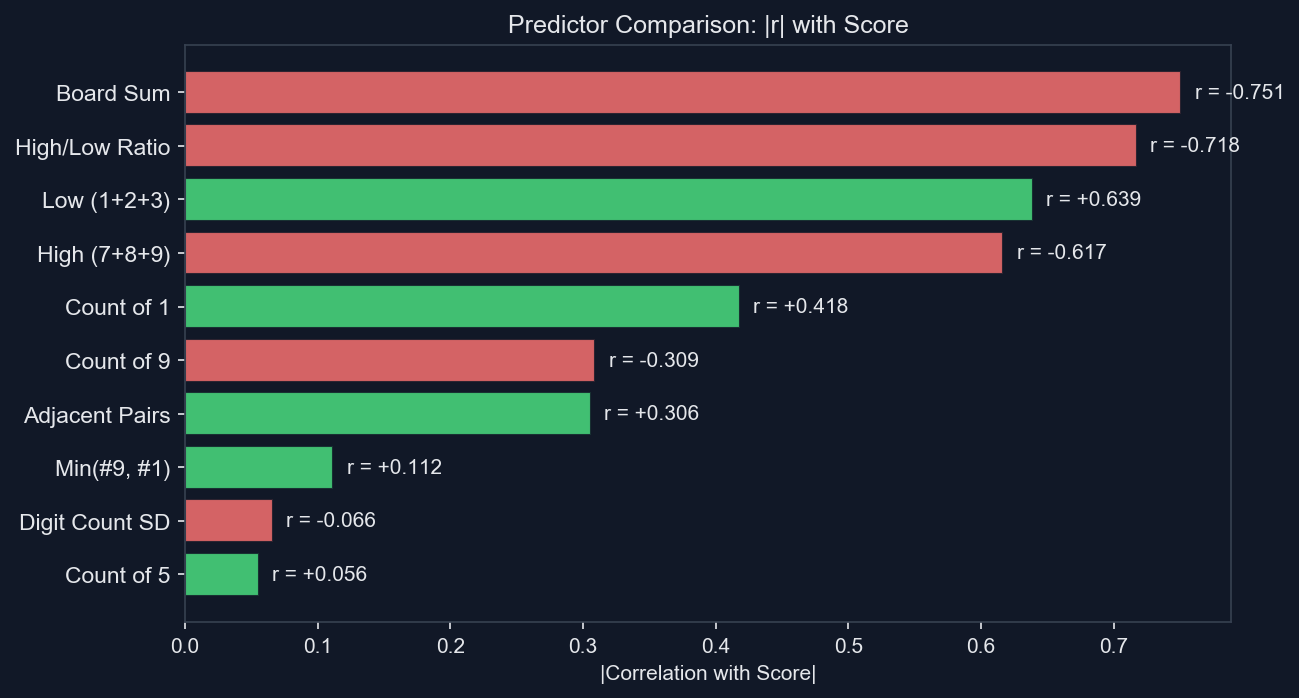
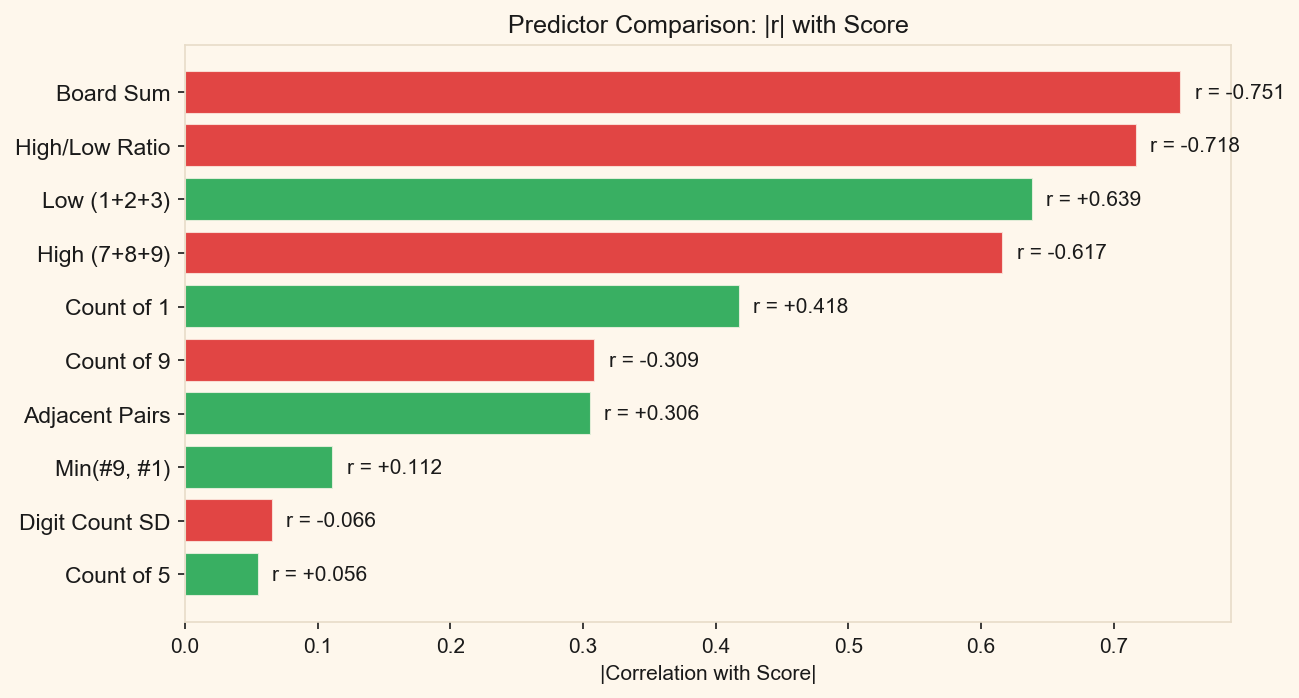
Of all the indicators we tested, the total sum of every digit on the board turned out to be the single strongest predictor of score. The correlation was substantial and negative (r ≈ −0.75): boards with a higher total sum consistently produced lower scores.
A high board sum means there are more large digits - 7s, 8s, 9s - scattered across the grid. Large digits are harder to pair off because they need correspondingly small partners to reach a sum of 10, and those small partners may not be nearby or may already be consumed. The result is that high-sum boards leave more cells unclearable, dragging the final score down.
This single number - just add up everything on the board - captures more information about expected score than any other metric we tried.
Other strong indicators
Several other features correlated with score, though none matched the predictive power of the board sum on its own.
The ratio of high digits (7, 8, 9) to low digits (1, 2, 3) was a strong runner-up. Boards dominated by high digits performed worse, while boards rich in low digits performed better. Closely related, the raw count of low digits (1, 2, 3) correlated positively with score - more small numbers means more flexible pairing options - and the count of high digits (7, 8, 9) correlated negatively.
Zooming in further, the count of 1s on the board and the count of 9s each showed notable effects. 1s are the most versatile digit: they pair with 9, and their small size keeps the board sum low. 9s are the opposite - they inflate the total, demand a 1 as a partner, and are generally the hardest digit to clear. These individual digit counts matter, but they're really just components of the board sum, which is why the sum itself remains the better overall predictor.
Surprisingly weak indicators
Some indicators that seem like they should matter turned out to be weaker than expected.
The number of adjacent pairs that sum to 10 - basically, how many "obvious" moves exist on the starting board - was only a moderate predictor. This is counterintuitive at first: surely a board with lots of ready-made pairs should be easier? But having many early moves doesn't guarantee that the remaining board will cooperate. A few easy pairs at the start can still leave behind an intractable mess of digits that refuse to align.
The count of 5s was similarly weak. Since two 5s sum to 10, you might expect boards full of 5s to score well. In practice, though, 5s are neutral - they neither inflate nor deflate the board sum relative to the average digit, and they can only pair with other 5s, limiting their flexibility.
Digit-count standard deviation - a measure of how evenly the nine digits are represented - also showed only a modest correlation. A perfectly balanced board doesn't automatically score well if the overall sum is high, and a skewed board can do fine if it's skewed toward small digits.
What this tells us
The pattern is pretty clear: score is driven less by obvious early opportunities and more by the overall composition of the board. Local features - like how many pairs you can immediately see - are noisy predictors. Global features - like the balance between large and small numbers - are far more reliable.
A greedy solver (or a human player) will find and clear the easy pairs regardless. What determines the final score is what's left after those easy moves are gone. And what's left is overwhelmingly shaped by the digit composition of the board as a whole.
The strongest signals turned out to be the simplest. Overall composition matters more than local patterns, and the total sum of all digits is the single best clue for how difficult a round will be. Lots of 7s, 8s, and 9s? Probably a hard one. Lots of 1s, 2s, and 3s? Easier.
For the full methodology and data, see our full difficulty analysis study.
All posts