

How Are Apple Game Boards Generated?
How are Apple Game boards actually generated? Why are some rounds hard and others easy? Are the numbers truly placed at random - or is someone arranging them on purpose? We analyzed 500 boards to find out the answer.
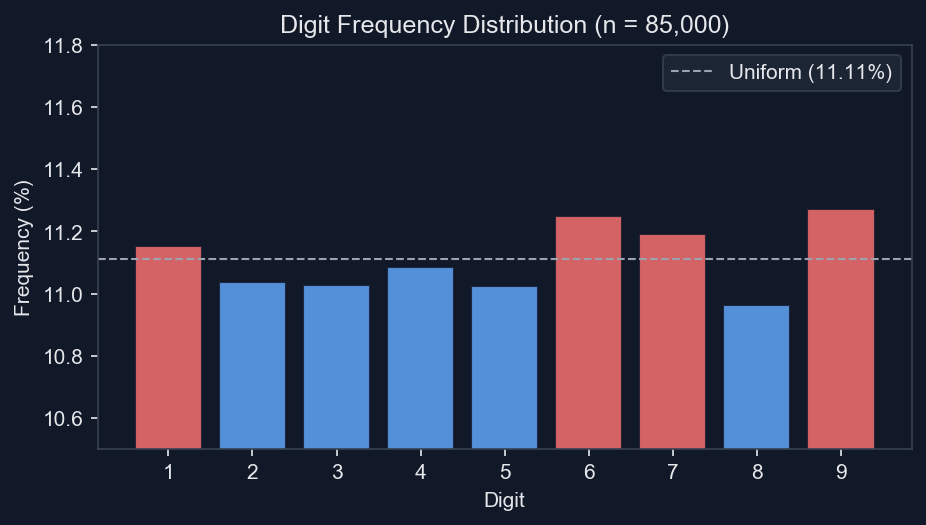
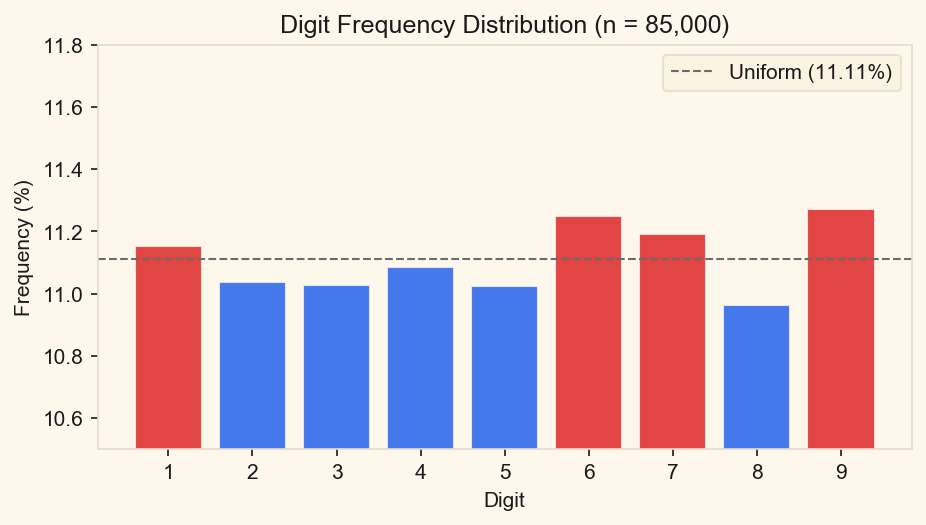
Based on an analysis of 500 boards and 85,000 numbers, there is no clear evidence that certain numbers appear more or less often than others.
So then why does difficulty vary from round to round, with some boards feeling noticeably harder or easier than others? If everything is random, shouldn't the results be roughly the same every time?
That inconsistency is actually normal. It is not a sign that someone is deliberately tuning the difficulty - it is simply the kind of variance you would expect from genuinely random generation.
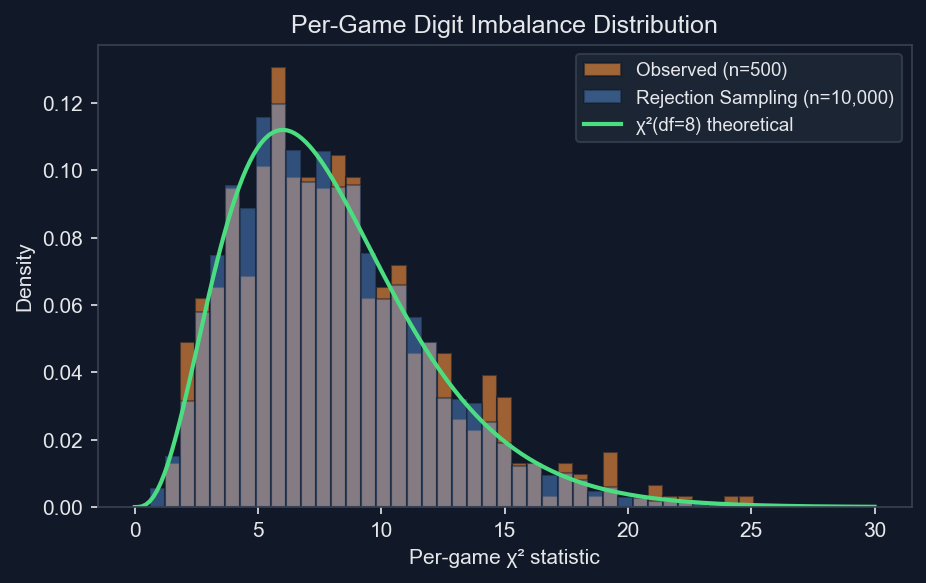
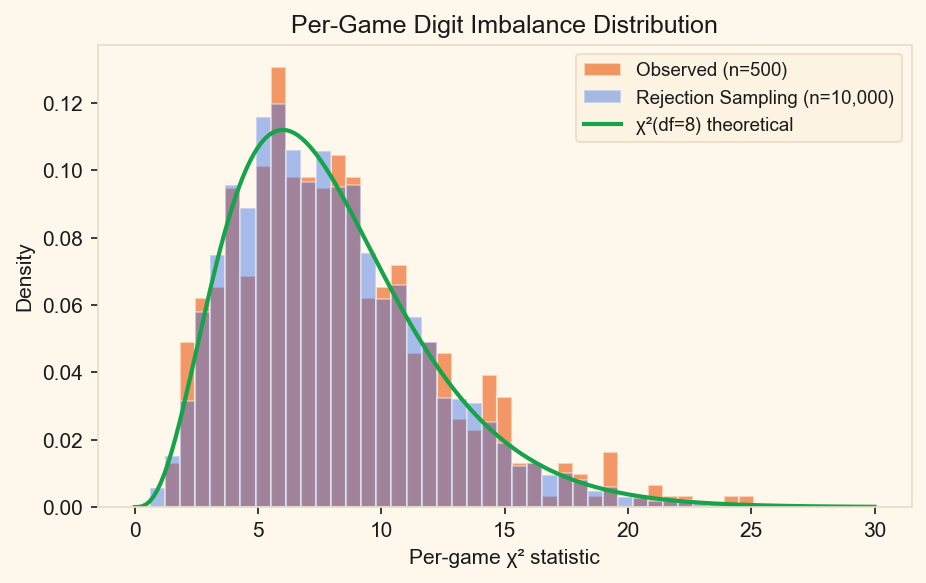
To test this more rigorously, we computed a chi-squared statistic for each board, measuring how much its digit distribution deviates from uniform. The chart above shows the distribution of those values across 500 real boards (orange), compared with 10,000 boards generated by rejection sampling (blue) and the theoretical chi-squared distribution with 8 degrees of freedom (green curve). They match closely. The real boards behave statistically the same as boards generated by simple random sampling with a sum constraint.
We think that's what keeps the game from getting boring. If every board played out the same way, you'd stop playing pretty quickly.
For the full methodology and data, see our full board generation study.
All posts